Falls Pathway For People Aged 50+
Introduction
Falls among adults aged 50 and over are one of the most significant drivers of ambulance callouts and emergency department attendances in Northern Ireland, with wide-reaching consequences for patient independence and for the capacity of both pre-hospital and hospital services.
However, the two organisations most involved in a patient’s journey following a fall have historically held their data in entirely separate systems.
The Northern Ireland Ambulance Service (NIAS) records the earliest point of contact. This includes the call, the dispatch category, and whether the patient was conveyed to hospital.
Separately, Health and Social Care Northern Ireland (HSCNI)’s Trusts capture what happens after arrival, including triage priority, clinical course, and eventual discharge or admission. This information is recorded in the encompass electronic patient record, which can be extracted and stored on the Northern Ireland Health Analytics Platform (NIHAP), which is managed by the HSC Data Institute (“the Data Institute”).
As these datasets were never designed to be analysed together, the HSC has had no single, evidence-based view of the full falls pathway, from the 999 call through to the patient’s eventual outcome in hospital.
In 2026, the Data Institute and NIAS signed a Memorandum of Understanding (MoU) to enable the sharing of data. Governance arrangements were put in place for an initial project to develop a better understanding of the full falls pathway.
To support delivery of the project through a systematic approach to data quality assessment grounded in established academic frameworks, the Data Institute collaborated with Queen’s University Belfast to offer a Data Analysis Master’s student placement.
Collaborating with academia
Following a competitive application process, Rachel Naveena EJ, an MSc Data Analytics student at Queen’s University Belfast, was placed within the Data Institute between June and September 2026.
Rachel’s background is in electronics and communication engineering, with almost a decade of professional experience spanning data engineering, business intelligence, and data governance across a range of sectors, including retail, pharmacy, healthcare, and banking.
Dr Natalie Fisher, Senior Data Scientist at the Data Institute, was assigned as Rachel’s dedicated supervisor. Natalie defined the scope of the project, provided domain and technical guidance throughout, and supported Rachel in navigating HSC data governance requirements.
Speaking about what attracted her to the project, Rachel said:
I’ve always been drawn to work where data isn’t analysed for its own sake, but translated into something a team can actually act on. This placement with the HSC Data Institute stood out because it offered a genuine operational challenge: linking ambulance and hospital data to better understand falls in older adults across Northern Ireland. It combined hands-on technical data science work with a clear public health outcome.
Discussing her placement, Rachel said:
Alongside my support from Natalie, I also had regular check-ins with Dr Laura Boyle, my lecturer at Queen’s University Belfast, to make sure the placement was delivering the academic experience and support I needed for my dissertation. This combination of hands-on operational supervision and academic oversight meant I had support from both sides throughout the project.
Linking the data accurately
This gap in available information was the starting point for the project. It was agreed that one year of NIAS dispatch data would be linked with encompass Emergency Department (ED) data for patients aged 50 and over who presented following a fall. The linked dataset would then be used to understand the falls pathway from end to end. The objective was to identify who is affected, how they are conveyed, and what happens to them clinically once they arrive at hospital.
Accurately linking two large administrative datasets using ambulance incident numbers required significant data quality work. This involved addressing mismatched data types between the two systems, inconsistent field naming conventions, and data quality issues, including missing identifiers, duplicated columns, and free-text fields that had to be mined for information not captured in structured fields.
This work required dedicated data science skills, including statistical programming, predictive modelling, and a systematic approach to data quality assessment grounded in established academic frameworks. The placement was specifically designed to bring these capabilities into the project.
Key findings and insights
The project successfully linked the two datasets, matching 62% of NIAS-conveyed falls incidents to a corresponding encompass ED record for the 2025/26 financial year. This novel dataset was validated by comparing how closely the timestamps recorded by each system for the same event aligned with one another.
A series of descriptive statistical analyses and trend analyses were performed to provide an overview of patient demographics and attendance patterns.
The most significant finding emerged from predictive modelling of hospital admission. A model built using only ED-recorded information for people with a fall-related keyword in the ED description (age, triage urgency, hospital site, and time of arrival) could significantly predict admission, rather than discharge, with a moderate degree of accuracy.
Adding the newly linked NIAS variables, most notably whether the fall occurred in a residential or institutional care setting, improved the model’s performance substantially. The care setting variable was identified as the single strongest predictor of admission in the entire study.
This finding suggests that, regardless of other factors, a person aged over 50 who experiences a fall is over three times more likely to be discharged rather than admitted if they come from a care home setting. This is a genuinely new and actionable insight for NIAS and HSCNI. It could only be identified by linking the two datasets and points directly to an area of the falls pathway that warrants further attention.
The admission model also revealed a weekend effect, with lower admission rates for patients arriving on Saturdays and Sundays. This pattern has direct implications for weekend staffing and service planning.
Beyond the admission prediction findings, the analysis identified meaningful variation between Trusts in both admission rates and length of stay. It also identified a median ambulance handover delay of 70 minutes (mean 107 minutes, with one in ten handovers taking longer than 232 minutes) as an operationally significant metric in its own right, independent of any falls-specific conclusions.
Lynne Charlton, Director of Quality, Safety and Improvement at the Northern Ireland Ambulance Service, said:
The collaboration between the Northern Ireland Ambulance Service and the HSC Data Institute demonstrates the power of data linkage to provide a more complete picture of patient journeys and outcomes across the health and social care system. By bringing together ambulance and hospital data, we are generating new insights into the care and experiences of older people that can help inform the HSC Reset agenda. Ultimately, this important work has the potential to support more integrated, preventative and person-centred services, improving outcomes for patients while helping us make the best use of available resources.
Dr Natalie Fisher, Senior Data Scientist at the Data Institute, said:
This project has demonstrated the significant value of connecting data across organisational boundaries. By creating the longest longitudinal dataset of its kind, it enables patients’ journeys to be tracked from an ambulance call through to their hospital outcomes, providing insights that would not have been possible from either dataset in isolation.
Looking ahead
The project leaves behind more than a set of findings and a valuable linked data asset. It has also produced a validated, reusable linkage methodology and a complete analytical pipeline that HSC and NIAS can build on using subsequent years of data. The approach can be extended with additional variables, such as deprivation measures when these become available, and applied to other patient groups beyond falls.
The project also identified several practical data quality improvements, including duplicated columns within the ED system, inconsistent field naming between systems, and invalid Ambulance Incident Numbers recorded in the ED system. Addressing these issues at source would significantly simplify future linkage work and improve data quality across both organisations.
Looking ahead, Dr Fisher added:
Rachel’s work has established a strong foundation for future collaboration between the HSC Data Institute and the Northern Ireland Ambulance Service. Building on this success, we plan to extend the approach through the SAPPHIRE programme, creating a linked dataset that brings together ambulance, care home, domiciliary care, emergency department and inpatient data to support patient flow analytics. By enabling a more comprehensive understanding of how people move through health and social care services, this work will support evidence-based service improvement and help organisations deliver more effective, integrated and person-centred care.
Reflections on the placement
Concluding her time working on the project, Rachel reflected:
For me personally, this project was not about learning that real data is messy, I already knew that. It was more about the specific challenges of health data: cross-organisational linkage and navigating information governance requirements I hadn’t worked with before. Almost every stage surfaced a problem that no data dictionary or system documentation had warned about, and the most valuable skill I developed was the habit of verifying every assumption empirically rather than trusting it. I also learned how much of applied data science work is translation: turning a statistical result like an odds ratio into a sentence a clinical or operational stakeholder can act on.
For NIAS, the Data Institute, and the HSC, I believe the project demonstrated the practical value of even a single year of linked data in surfacing insights neither organisation could reach from its own records alone, and hopefully makes the case for continuing and deepening this kind of collaboration.
Reflecting on Rachel’s work, Julia Wolfe, Research and Development Lead at the Northern Ireland Ambulance Service, said:
It has been fantastic to involve Rachel, an MSc student, through a summer placement. She has gained valuable hands-on experience in analysing linked prehospital and hospital data, while making an important contribution to the project. It’s been a great example of how collaboration can benefit both the research and the people involved.
Dr Laura Boyle, Data Analytics Lecturer at Queen’s University Belfast, said:
Collaborations between Queen’s University Belfast and the Data Institute provide our MSc students a unique opportunity to bridge academic study with practical application. By working on live projects, students can see how the knowledge and skills developed through their studies can contribute to addressing real-world challenges within health and social care. Rachel embraced this opportunity, contributing to the project while developing her analytical, communication, and professional skills. Experiences like this help prepare students to become the next generation of data analysts, capable of making a meaningful impact.
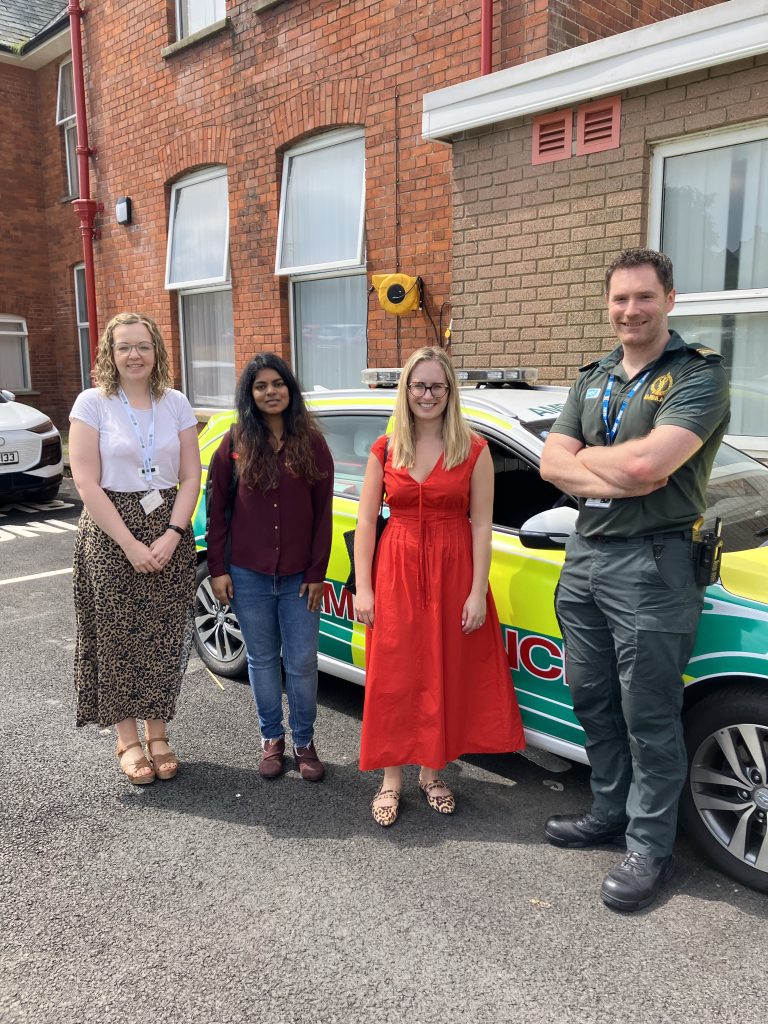
Julia Wolfe and Karl Bloomer from the Northern Ireland Ambulance Service (NIAS) welcomed Rachel Naveena EJ and Dr Natalie Fisher from the HSC Data Institute for a tour of NIAS. The visit supports a Data Institute and NIAS initiative combining data to better understand end-to-end patient journeys following a fall. Pictured (L-R): Julia Wolfe (Research and Development Lead, NIAS), Rachel Naveena EJ (MSc Student Placement, HSC Data Institute), Dr Natalie Fisher (Senior Data Scientist, HSC Data Institute), and Karl Bloomer (Urgent Care Consultant Paramedic, NIAS).
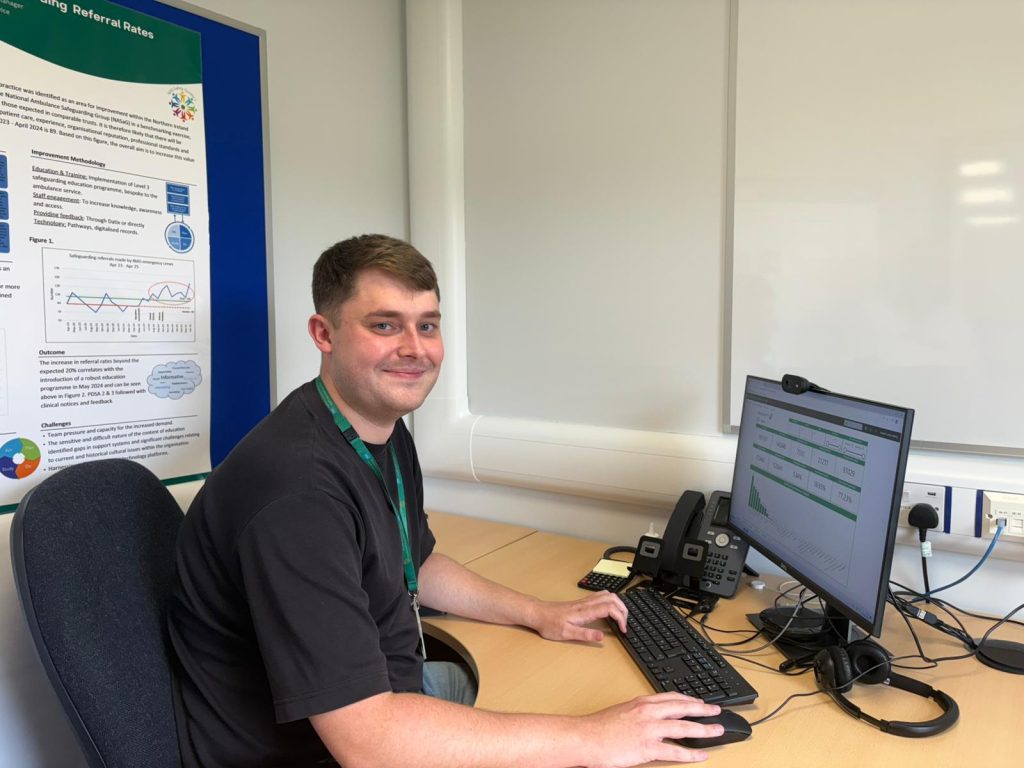
Daniel Corken, Data Analyst at the Northern Ireland Ambulance Service (NIAS), led NIAS’s data analysis work for the project.
Page last updated: 12 October 2026